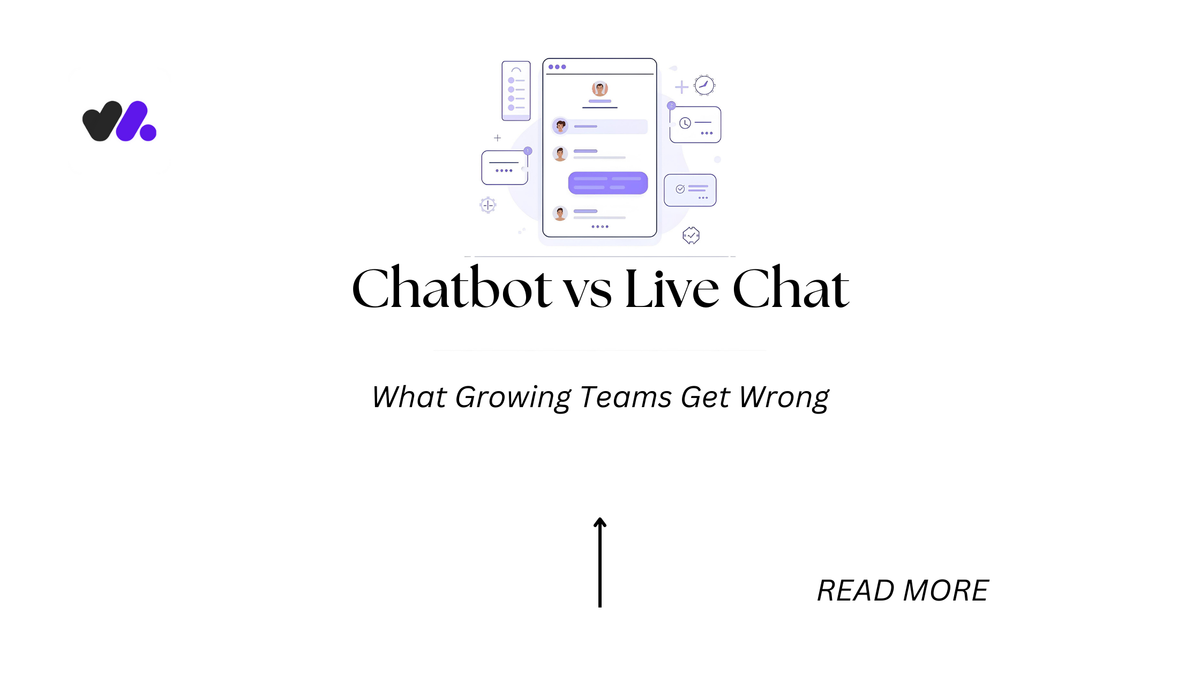
Chatbot vs Live Chat: What Growing Teams Get Wrong
“Should we use a chatbot or live chat?”
It’s one of the most common questions growing teams ask when setting up customer support.
And it’s the wrong question.
The real problem isn’t choosing between chatbots and live chat, it’s how most teams implement them.
When done poorly, chatbots frustrate users.
When done poorly, live chat overwhelms teams.
But when designed together, they become one of the most effective support systems a business can have.
Why This Debate Keeps Happening
As teams grow, support volume increases.
Suddenly:
- Agents are overwhelmed
- Response times slow down
- The same questions appear again and again
So teams look for a fix.
Some jump straight into automation.
Others double down on human support.
Both approaches fail when used in isolation.
Where Chatbots Actually Work Well
Chatbots are not the problem.
Misuse is.
Chatbots work best when they:
- Answer repetitive, predictable questions
- Guide users to the right resources
- Collect context before handing over to a human
- Operate outside business hours
Used this way, chatbots reduce noise and free up human agents to handle meaningful conversations.
The mistake many teams make is expecting bots to handle everything.
Where Live Chat Is Essential
There are moments automation should never replace.
Live chat is critical when:
- A user is confused or stuck
- A decision needs reassurance
- An issue is sensitive or complex
- A customer is close to converting
In these moments, speed and empathy matter more than efficiency.
A chatbot can guide.
Only a human can understand nuance.
The Real Issue: Lack of Flow
Most support setups fail because there’s no clear flow between automation and human support.
Users get stuck in loops.
Bots don’t know when to step aside.
Agents don’t have enough context when they join.
This creates friction — not efficiency.
The best support experiences are designed as a journey:
- Bot first, when appropriate
- Human when needed
- Smooth handoff without repeating information
What a Smart Support Setup Looks Like
A modern support system should:
- Greet users instantly
- Use automation to handle simple questions
- Offer self-service options clearly
- Escalate to a human without friction
- Keep conversation history intact
This isn’t about choosing sides.
It’s about designing balance.
How Widgion Brings It All Together
Widgion is built to eliminate the chatbot vs live chat dilemma entirely.
With Widgion, teams can:
- Deploy chatbots to handle FAQs and routine questions
- Offer live chat when users need real-time human help
- Configure bot-to-human handoff based on intent or behavior
- Connect conversations to a Help Hub for self-service
- Manage everything from one unified workspace
Instead of forcing users into rigid flows, Widgion lets teams design support around real customer needs.
Scaling Support Without Breaking Experience
As teams grow, the goal shouldn’t be to replace humans with bots.
It should be to:
- Use automation to remove friction
- Use humans where trust matters
- Maintain consistency across every interaction
This approach scales support without sacrificing experience — and without burning out teams.
Final Thought
The future of customer support isn’t chatbots or live chat.
It’s both — working together.
Teams that understand this build faster, more human, and more scalable support systems.
Widgion exists to help teams design that balance from day one.